My research program sits at the intersection of microbiology, ecology, and evolutionary biology. Specifically, I focus on bacterial evolution, which can occur extremely rapidly and has implications from pathogenicity and antibiotic resistance to biotechnology or microbiome function. However, most bacteria do not live alone. Instead, they have complex associations with other species that span many scales and trophic levels. Whether colonizing a eukaryotic host or coexisting in a multispecies community of bacteria and phages, interactions define the evolutionary pressures that likely shape bacteria in the wild. Yet, we know little about how these interactions actually do shape bacteria. To address this gap, my research seeks to build an integrative understanding of how bacterial evolution is shaped by interactions with animal hosts, bacteriophages, and other bacterial species. Throughout, I use a unique combination of laboratory experiments and mathematical modeling: strengthening my experiments by testing model predictions, motivating my modeling from empirical patterns, and mathematically generalizing my experimental findings.
Innate immunity and the evolution of pathogen virulence
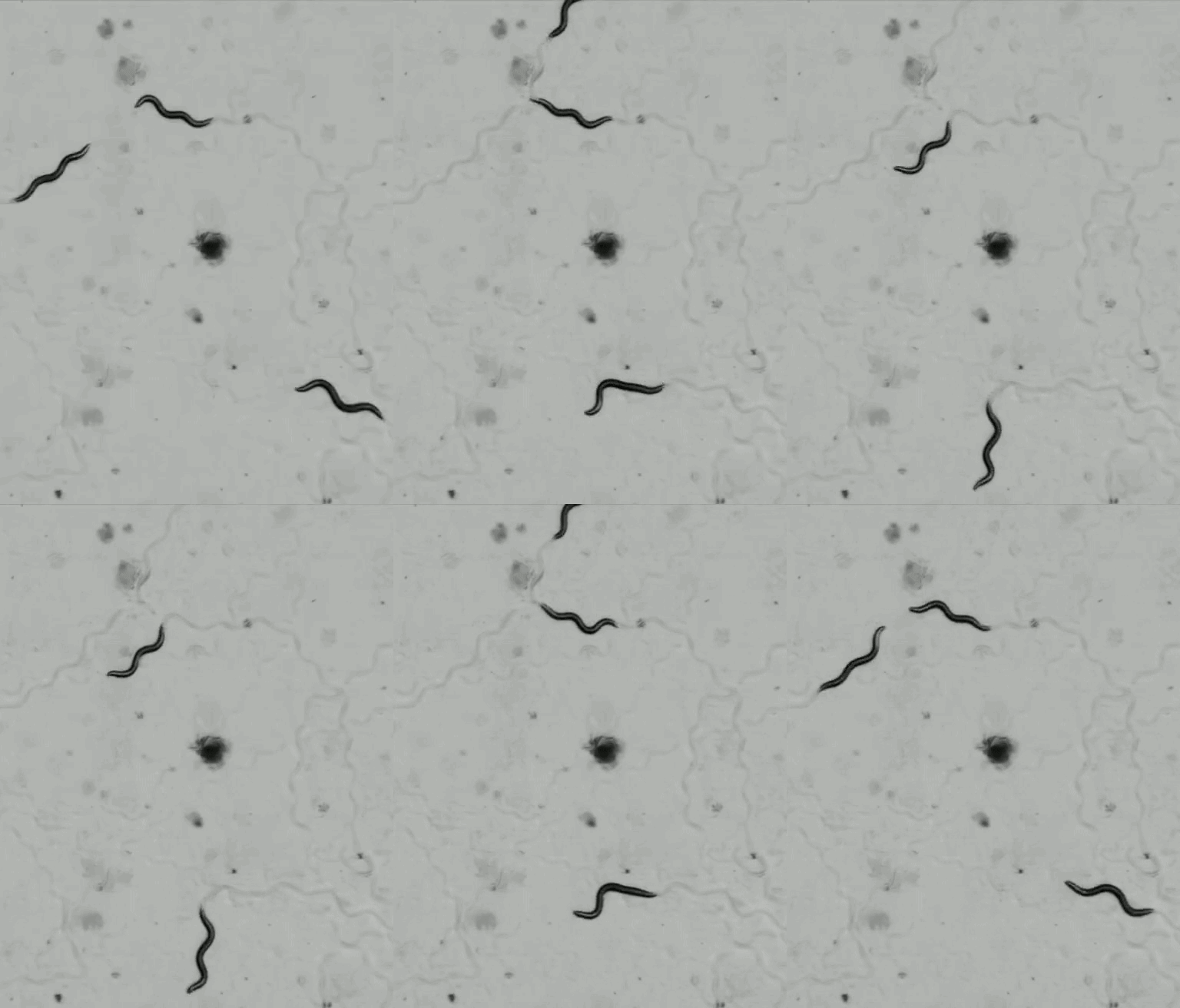
The harm that pathogens cause to a host (virulence) can evolve rapidly. Virulence evolution can be shaped by many factors, but one outsized influence is the host’s immune system. Mathematical modeling has predicted that strengthened immunity can drive the evolution of increased or decreased virulence, depending on the stage of infection when immunity operates. To empirically test these predictions, we first characterized a panel of Caenorhabditis elegans nematode strains with single-gene knockouts in several central innate immune pathways. We quantified how these knockouts altered resistance to infection by the opportunistic pathogen Pseudomonas aeruginosa across each stage of infection: initial exposure, establishment, colonization, and mortality. Our data revealed that resistance is sometimes correlated across these stages and that innate immunity is often highly pleiotropic. We are now leveraging this variation to experimentally test how immunity shapes virulence evolution. We are experimentally evolving P. aeruginosa to adapt to hosts with distinct immune profiles. At the same time, we are building models to specifically predict how host killing will evolve depending on each host strain’s immune profile. Ultimately, we aim to establish whether distinct mechanisms of innate immunity have predictable effects on the evolution of pathogen virulence.
Phage-bacteria coevolution in multispecies communities
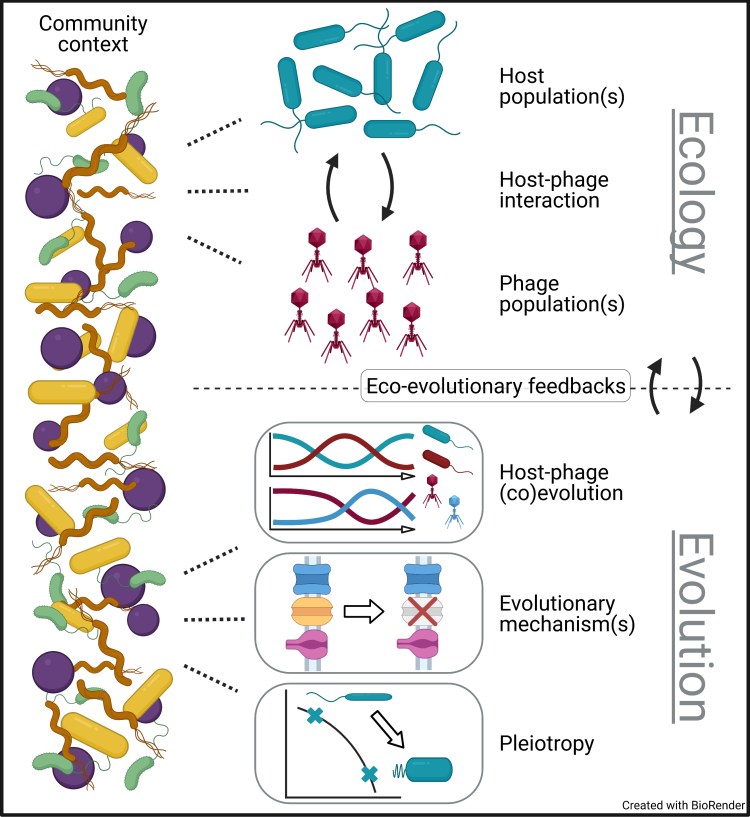
Bacteria-phage symbioses are ubiquitous in nature and serve as valuable biological models. Historically, the ecology and evolution of bacteria-phage systems have been studied in either very simple or very complex communities. Although both approaches provide insight, their shortcomings limit our understanding of bacteria and phages in multispecies contexts. To address this gap, we recently published a review and meta-analysis arguing that non-host bacterial species are an important driver of phage-bacteria ecology and evolution:
M Blazanin and PE Turner. Community context matters for bacteria-phage ecology and evolution.
Additionally, we have used synthetic microbial communities to experimentally quantify the importance of other bacterial species on the evolution and coexistence of a bacteria and phage. We experimentally evolved P. aeruginosa and a Pseudomonas-specific phage in the presence or absence of other ecologically-relevant bacterial species Our data showed that the presence of other bacterial species fundamentally altered the evolutionary response, constraining the evolution of resistance to phage infection and fostering diversity by favoring coexistence between phages and bacteria.
Parasite-driven evolution of bacterial avoidance
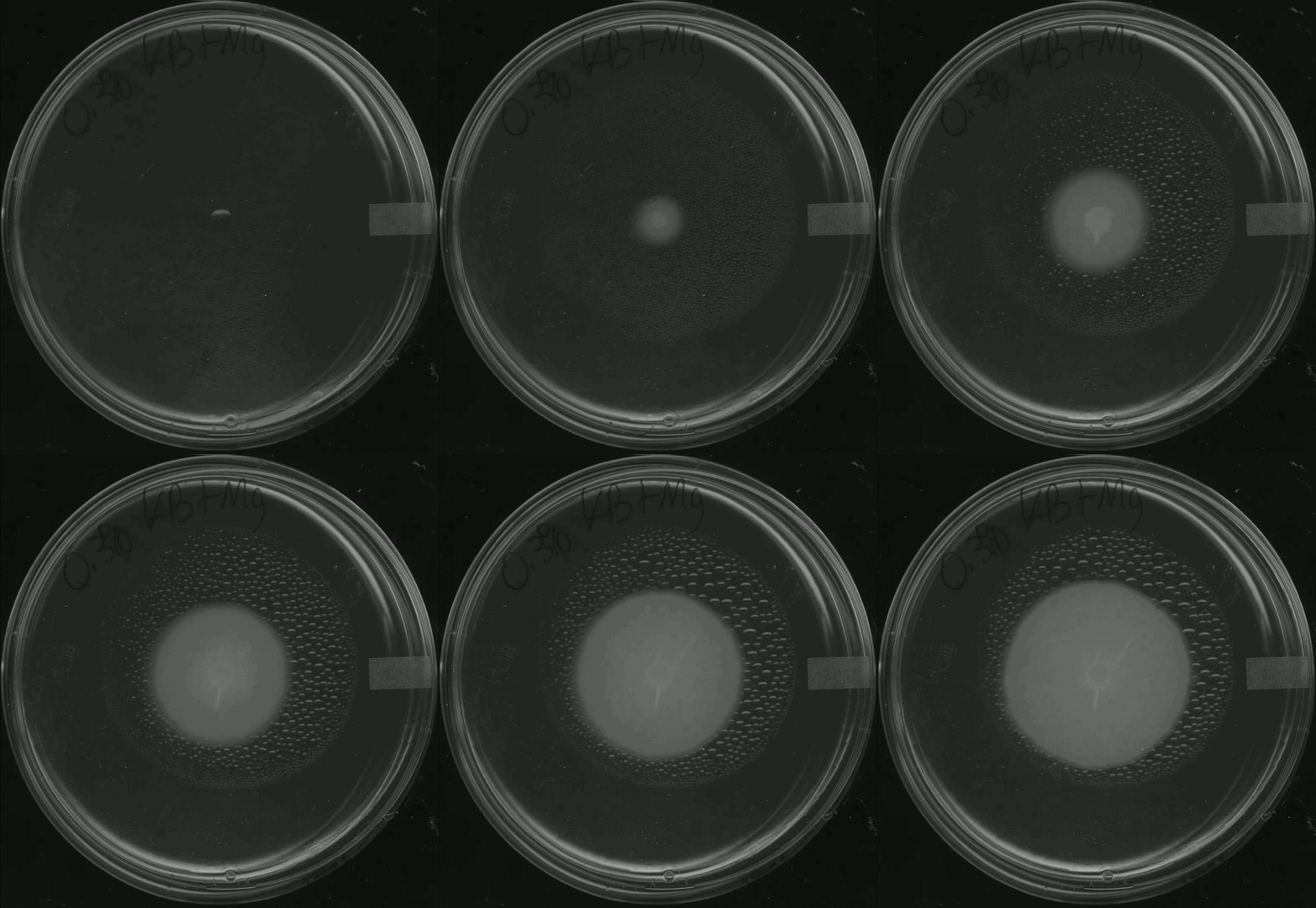
In the face of ubiquitous threats from parasites, hosts often evolve strategies to resist infection or to altogether avoid contact with parasites. At the microbial scale, bacteria frequently encounter viral parasites, bacteriophages. While bacteria are known to utilize a number of strategies to resist infection by phages, and can physically navigate their environment using complex motility behaviors, it is unknown whether bacteria evolve avoidance of phages. In order to answer this question, we combined experimental evolution and mathematical modeling to test whether, and under what conditions, bacteria will evolve to avoid viral parasites.

gcplyr: an R package for microbial growth curve data analysis
Characterization of microbial growth is of both fundamental and applied interest. Modern platforms can automate collection of high-throughput microbial growth curves, necessitating the development of computational tools to handle and analyze these data to produce insights. However, existing tools are limited. Many use parametric analyses that require mathematical assumptions about the microbial growth characteristics. Those that use non-parametric or model-free analyses often can only quantify a few traits of interest, and none are capable of importing and reshaping all known growth curve data formats. To address this gap, I developed and recently released a new R package:
M Blazanin. gcplyr: an R package for microbial growth curve data analysis.
gcplyr can flexibly import growth curve data in every known format, and reshape it under a flexible and extendable framework so that users can design custom analyses or plot data with popular visualization packages. gcplyr can also incorporate metadata and generate or import experimental designs to merge with data. Finally, gcplyr carries out model-free and non-parametric analyses, extracting a broad range of clinically and ecologically important traits.
Growth curves as a high-throughput method to quantify phage-bacteria interactions
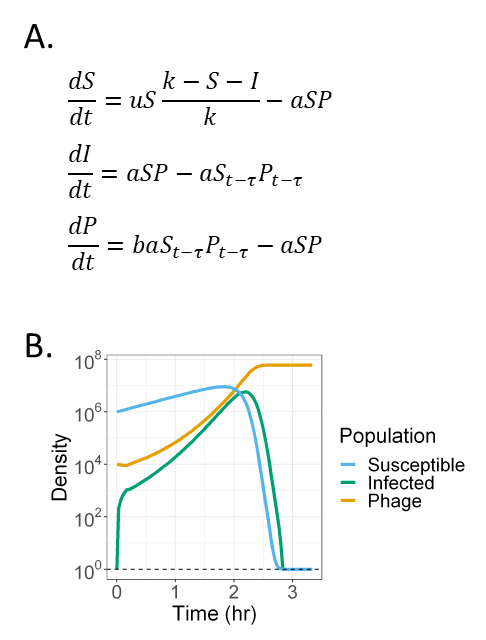
Quantitative measures of bacteriophage infectivity are essential to understanding bacteria – phage interactions across a range of domains and applications, from human health to fundamental research. However, existing methods, like cross-streaks, spot tests, and efficiency of plaquing assays, have limitations. Most notably, these assays experience strong tradeoffs between the resolution of infectivity data and the throughput of the assay, with high-throughput assays providing little more than a binary measure of infectivity. We set out to bridge this gap by improving a high-throughput method already in widespread use: growth curves. Growth curves consist of a time series of bacterial density data, and are often used to identify the presence of phage-induced lysis. In this project, we use mathematical modeling and in vitro experiments to show whether and how growth curve data can, in fact, produce high-resolution measures of phage infectivity.